
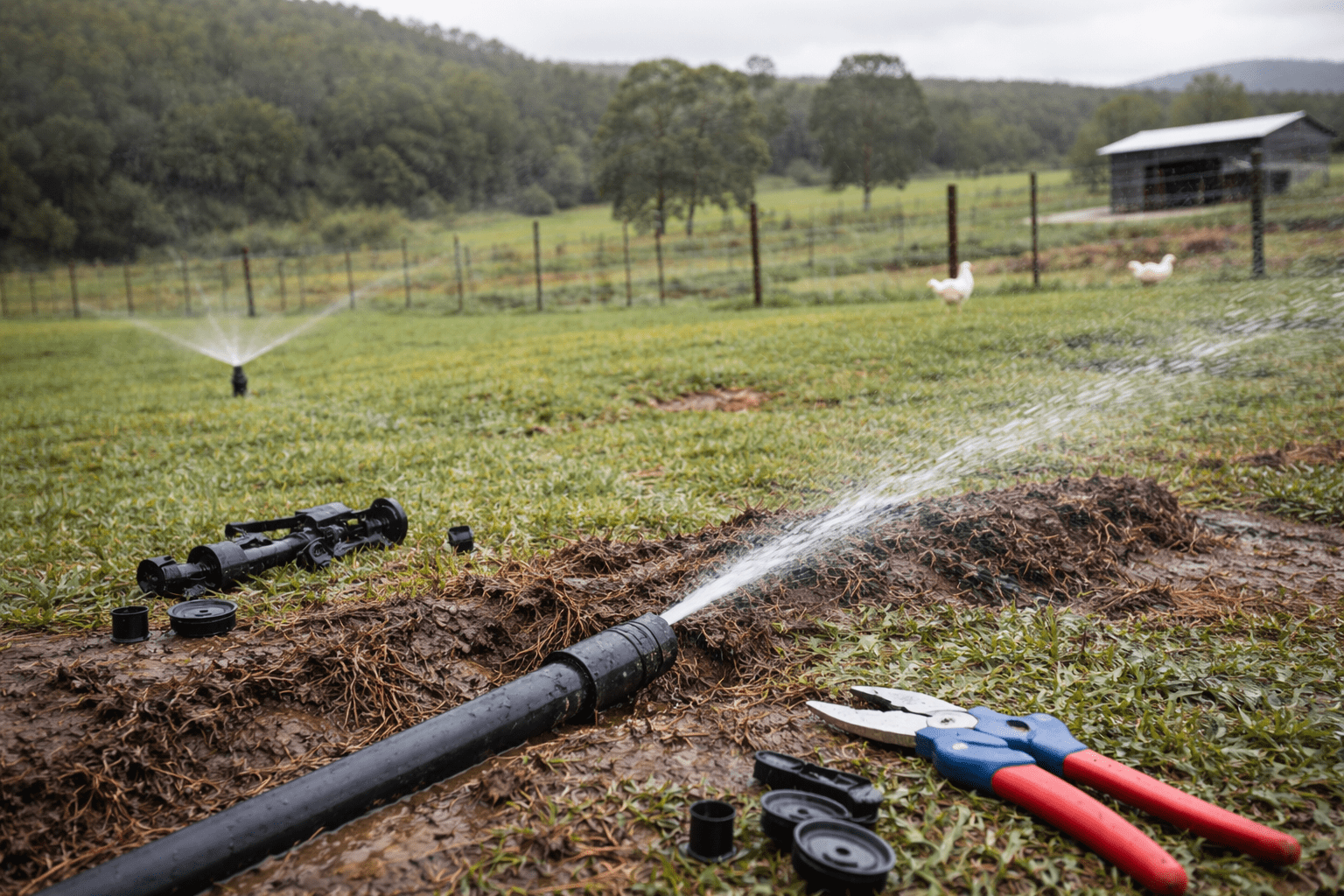
A well-functioning irrigation system should do its job quietly in the background: watering your lawn, garden, or crops consistently, efficiently, and without wasting a drop. When something goes wrong, the signs are often gradual enough that they go unnoticed until the problem has been building for weeks.
Whether you’re managing a residential garden in Warwick, a hobby farm in the Southern Downs, or a larger rural property, catching irrigation problems early saves water, money, and the plants or pasture that depend on reliable coverage. Here are the seven most common signs that your irrigation system needs attention, and what each one is likely telling you.
1. Dry or Patchy Areas That Aren’t Getting Better
Why Is Part of My Lawn Always Dry?
Dry patches that persist despite regular watering are one of the clearest signs that something in your irrigation system isn’t working as it should. If water isn’t reaching certain areas, the cause is almost always a distribution problem rather than a weather issue.
The most common culprits include blocked or clogged sprinkler heads that have become restricted by debris or mineral buildup, damaged heads that are no longer operating correctly, or a zone that has lost pressure and is no longer delivering adequate coverage. In some cases, dry patches indicate a design problem where the system was never set up to cover the full area properly in the first place.
In the Southern Downs, where summer heat can stress lawns and crops quickly, an irrigation gap that might be manageable in a cooler climate can cause real damage within days. If you’re seeing persistent dry spots, it’s worth having the system inspected before the problem gets worse.
- Blocked or worn sprinkler heads not delivering water to the zone
- Pressure loss in one or more circuits
- Poor original system design leaving coverage gaps
- A head that has been knocked out of alignment by mowing or foot traffic
2. Water Pooling or Soggy Areas After Watering
Why Is Water Collecting in the Same Spot Every Time?
Just as dry patches signal too little water reaching an area, persistent pooling tells you that too much water is being concentrated in one spot. This is a waste issue and a plant health issue simultaneously: waterlogged soil starves roots of oxygen and creates conditions for fungal disease, while the water sitting on the surface is evaporating rather than being absorbed where it’s needed.
Pooling is commonly caused by a sprinkler head that is broken and releasing water uncontrollably rather than distributing it as a spray, by pressure that is set too high for the heads in that zone, or by a head that has been set to the wrong angle and is directing water onto a non-absorbent surface rather than into the soil.
Underground leaks can also cause soggy patches. If an area of your garden or lawn is consistently wet even on days when the system isn’t running, there’s a good chance a pipe or fitting underground is leaking. These leaks are not always obvious from the surface, but they waste significant water over time and can erode the soil around your pipes if left unaddressed.
3. Your Water Bill Has Gone Up Without Explanation
Could My Irrigation System Be Causing a Higher Water Bill?
An unexplained increase in your water bill is often the first financial sign that something is wrong with an irrigation system. Even a small leak or inefficiency can accumulate into a significant volume of wasted water across a full billing period.
Underground pipe leaks are a common cause that often goes visually undetected for months, particularly in established gardens where the surface appearance doesn’t change noticeably. Older systems with worn fittings or corroded connections can develop slow leaks at multiple points simultaneously, and the combined waste adds up quickly.
Outdated controllers that are running zones for longer than necessary, or systems that haven’t been adjusted seasonally, are also common culprits. A system running a full summer schedule through winter, or continuing to run during and after rainfall, is wasting water with every cycle.
If your bill has jumped and your water usage habits haven’t changed, having your irrigation system pressure-tested and inspected is a sensible first step. Our pumping solutions and irrigation services cover exactly this kind of diagnostic work.
4. Noticeably Weak or Reduced Water Pressure
Why Are My Sprinklers Not Reaching as Far as They Used To?
If your sprinkler heads are producing a weak dribble rather than a proper arc, or if the spray is falling well short of where it used to reach, you have a pressure problem. Reduced pressure means reduced coverage, and reduced coverage means your plants and lawn are not getting what they need.
Pressure loss in an irrigation system can have several causes. A pipe leak somewhere in the system, even a small one, diverts flow and reduces the pressure available at the heads. Blockages in pipes or fittings, particularly common in areas with hard water or where bore water is used, can restrict flow significantly over time. Pressure regulation issues, where the system’s pressure regulator is set incorrectly or has failed, are another common cause.
In rural properties across the Southern Downs that draw from dams, bores, or rainwater tanks, pump performance degradation over time can also produce symptoms that look like a system problem but are actually a pump problem. If pressure has dropped gradually over a season or two, it’s worth having both the system and the pump assessed together.
5. Damaged, Stuck, or Misaligned Sprinkler Heads
How Do I Know If My Sprinkler Heads Are Damaged?
Sprinkler heads sit at ground level in lawns and garden beds, which means they take a lot of wear from mowing, foot traffic, vehicles, and general garden activity. They’re the most physically exposed part of any irrigation system, and they’re also the most commonly damaged.
A pop-up head that no longer rises fully is either clogged with debris, has a worn or damaged seal, or is stuck in the housing. A head with a cracked body will leak water around its base rather than directing it through the nozzle. A head that has been knocked sideways is spraying in the wrong direction, potentially wasting water on paving or fences while leaving the intended area dry.
Inspecting your sprinkler heads while the system is running gives you the most useful picture. Walk each zone while it’s active and look for heads that aren’t operating correctly. Any head that is leaking, not rising, cracked, or directing spray in the wrong direction should be replaced. Sprinkler heads are relatively inexpensive components, and replacing a damaged head is one of the quickest wins available in irrigation maintenance.
- Heads that don’t fully pop up or retract
- Cracked bodies or visible leaks around the base
- Spray patterns that are visibly off-angle or uneven
- Heads that spin erratically or produce a broken spray
6. An Outdated System with No Automation or Smart Controls
Is It Worth Upgrading to an Automated Irrigation Controller?
Older irrigation systems that run on manual timers, or worse, require someone to physically turn them on and off, are almost always delivering water less efficiently than a modern automated system would. The technology available today compared to even ten years ago is significantly better in terms of water efficiency, flexibility, and ease of management.
Modern irrigation controllers allow you to set different schedules for different zones, adjust run times seasonally, and in the more advanced models, connect to weather data so the system automatically reduces or skips watering cycles after rainfall or when humidity is high. For residential properties, this kind of automation takes the guesswork out of irrigation management entirely. For larger rural and agricultural properties, smart control can make a meaningful difference to both water use and operating costs over a full season.
If your current system has no controller at all, runs a single schedule across all zones regardless of their different water requirements, or requires you to manually manage watering, it’s almost certainly using more water than necessary. An upgrade to a programmable or smart controller is one of the most cost-effective improvements available to any irrigation system. You can explore the options available through our centre pivot automation and irrigation control services.
7. The System Runs the Same Schedule All Year Round
Should My Irrigation Schedule Change with the Seasons?
This is one of the most common and easily fixed inefficiencies we see in irrigation systems across the Southern Downs region. A system set up in January for peak summer conditions and never adjusted will be significantly overwatering through the cooler, wetter months, and may be underperforming during an unexpectedly dry spring or autumn period.
In the Warwick region, where seasonal variation is significant and drought conditions can arrive quickly, an irrigation system needs to respond to actual conditions rather than running a fixed programme regardless of what the weather is doing. Overwatering during winter encourages shallow root systems that are less resilient when summer heat arrives. Underwatering during an unexpected dry spell causes preventable stress to plants, lawns, and crops.
The solution is either regular manual adjustment of your controller as seasons change, or upgrading to a smart controller that can make those adjustments automatically based on temperature, rainfall, and evaporation data. Either way, a seasonal review of your irrigation schedule is one of the simplest things you can do to improve the performance of your system and reduce water waste.
Should You Repair or Upgrade Your Irrigation System?
Once you’ve identified a problem, the question becomes whether it makes more sense to repair the existing system or invest in an upgrade. The answer depends on a few key factors.
Repair is usually the right call when:
- The system is relatively new and the problem is isolated to one or two components
- The issue is a damaged head, a minor leak, or a blocked nozzle
- The overall design and coverage of the system is sound
An upgrade makes more sense when:
- The system is old and recurring problems are becoming a regular maintenance burden
- The coverage design no longer suits the landscape as it has grown and changed
- There is no automation and water bills reflect the inefficiency
- You’ve expanded your property or changed what you’re growing and the existing system can’t keep up
In many cases, a partial upgrade is the most practical approach: keeping the pipe infrastructure that is still sound while replacing heads, controllers, and fittings with modern, more efficient equivalents. A proper assessment by an irrigation specialist is the best way to determine what makes sense for your specific situation.
Frequently Asked Questions
How do I know if my irrigation system is wasting water?
The most common indicators are a higher than expected water bill, visible pooling or soggy areas in your garden, and dry patches that persist despite the system running. If any of these are present, it’s worth having a professional inspect the system for leaks, blockages, or pressure issues. Even small leaks can waste thousands of litres over a billing period.
Should I repair or replace my irrigation system?
If the system is relatively new and the issue is isolated, repair is usually the more cost-effective option. If the system is old, frequently causing problems, or significantly inefficient by modern standards, upgrading all or part of the system will often deliver better long-term value. An inspection by an experienced irrigation specialist will give you an honest assessment of which path makes sense for your setup.
How often should an irrigation system be checked?
A thorough inspection at least once a year is a good baseline for most residential and rural properties. The best time to do this is before your peak watering season begins, so any problems can be identified and resolved before you’re relying heavily on the system. For larger agricultural or commercial systems, more frequent checks are advisable.
Can a new irrigation system reduce my water bills?
Yes, significantly in most cases. Modern irrigation systems with smart controllers, pressure regulation, and correctly specified heads and nozzles are designed to deliver the right amount of water to the right areas without waste. Properties upgrading from older, unregulated systems often see a noticeable reduction in water use from the first billing period.
My system runs but some areas are always dry. What should I check first?
Start by running each zone individually and walking the area while it’s active. Look for heads that aren’t popping up, spray patterns that look uneven or weak, or heads that are clearly pointed in the wrong direction. If all heads appear to be working but coverage is still inconsistent, a pressure or flow issue in that zone may be the cause, which is worth having inspected by a professional.
Does Lister Irrigation service rural and agricultural properties as well as residential?
Yes. Lister Irrigation works with residential, rural, and agricultural clients across Warwick and the broader Southern Downs region. From home garden irrigation to large-scale farm water systems, bore pumps, and centre pivot automation, we have the expertise and local knowledge to help with the full range of irrigation challenges specific to this part of Queensland.
Keep Your Irrigation System Working for You
An irrigation system that isn’t performing properly costs you water, money, and the health of everything that depends on it. Whether you’re dealing with a dry patch that won’t recover, a water bill that keeps climbing, or a system that simply hasn’t been looked at in years, the right starting point is a proper inspection by someone who knows what to look for.
At Lister Irrigation, we’ve been helping homeowners, farmers, and businesses across the Southern Downs keep their water systems running efficiently for years. We offer honest advice, practical solutions, and the local knowledge that comes from working in this region day in and day out.
If your irrigation system is showing any of the signs above, get in touch with our team today to arrange an inspection or discuss what your system needs.